Trainer's Notebook: a gym diary that works without signal
Personal trainers still log sessions on paper or in random phone notes. I built Trainer's Notebook, an offline-first PWA for clients, sessions and personal bests.
If you’ve ever trained with a PT, you’ve probably seen it: a battered paper notebook, or a phone full of notes like “Anna squat 70x6 felt easy??”. Somehow it all lives in the trainer’s head, and good luck finding what someone lifted three weeks ago.
I thought that could be a lot nicer. So I built Trainer’s Notebook (Zeszyt Trenera in Polish, which is the language it speaks first).
What it does
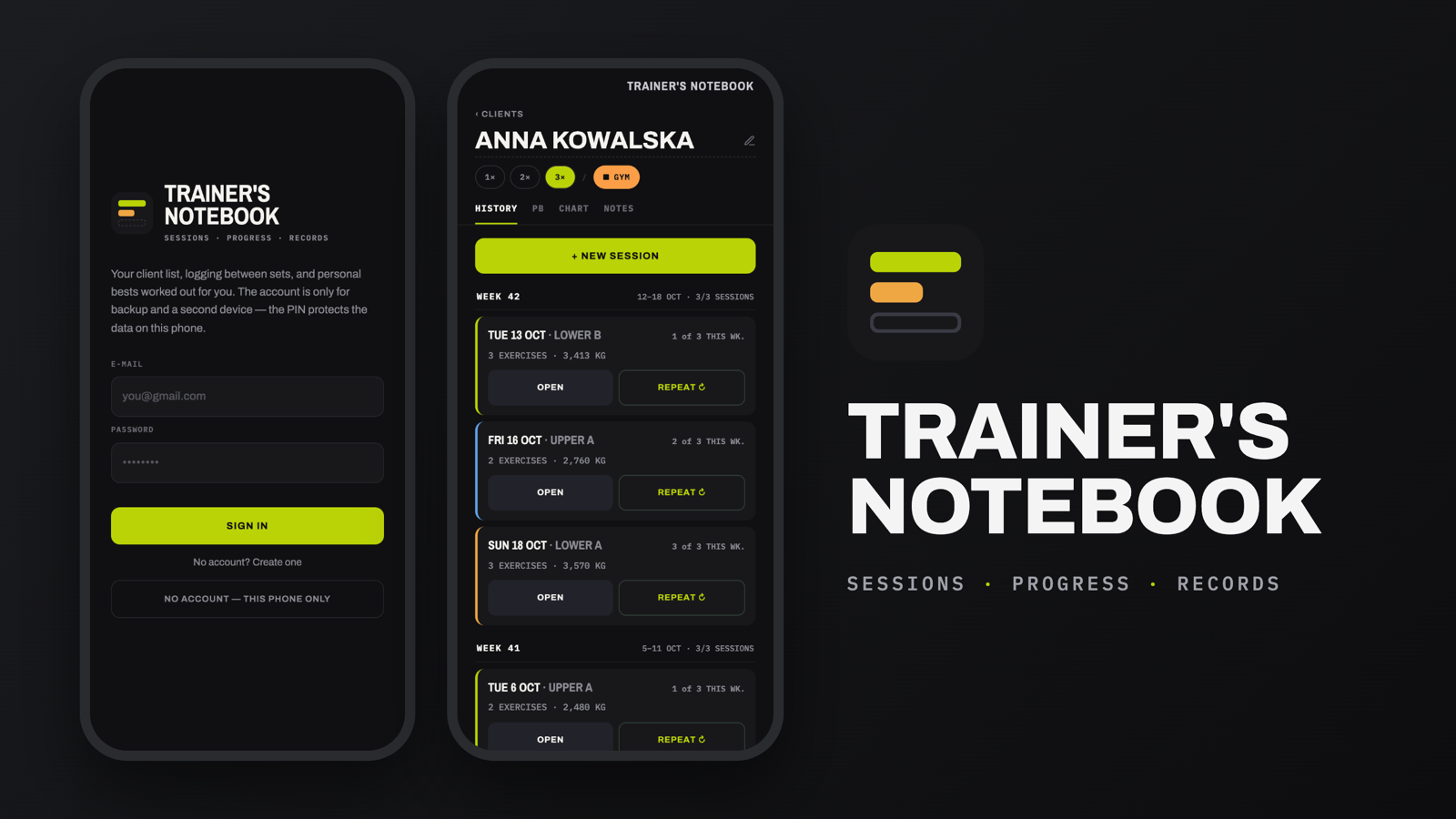
It’s a mobile-first PWA made for using between sets, with sweaty hands and zero patience:
- A client list you can filter by how often people train (1, 2 or 3 times a week) and where (gym or studio)
- Session logging with sets, reps, weight, RIR and supersets. Hit “Repeat” and the last session becomes a template, with the previous numbers shown as hints
- Personal bests and charts worked out automatically from what you’ve logged
- Notes for goals, injuries and equipment settings
- A PIN lock, because client notes can include health information and the phone often sits on a bench
It’s in Polish, English and German, and the design is dark, chunky and high contrast so you can read it from a step away.
The tricky part: gyms have terrible signal
This was the fun bit to build. Gyms are often in basements, and an app that spins forever while you’re trying to log a set is useless. So the app is offline first.
Here’s how it works:
- The UI only ever reads from a local database in the browser (I used Dexie, a lovely wrapper around IndexedDB)
- Every change is saved locally first and added to a queue
- When the phone is back online and signed in, the queue sends everything to Supabase in order
A few details made a big difference. Every row gets its ID on the phone, so sending the same change twice is harmless. The queue stops at the first failure, so a session can never arrive before the client it belongs to. And a session in progress is saved as a draft, so locking the phone mid-workout doesn’t lose anything.
You don’t even need an account. “This phone only” mode keeps everything on the device, and if you sign up later, your data comes with you.
The stack
- React 19 + TypeScript + Vite
- Tailwind CSS 4
- Dexie for the offline database
- Supabase for auth and backup, with row level security so each trainer only sees their own clients
- react-i18next for the three languages
- Cloudflare Pages for hosting
What I learnt
Offline first is a mindset, not a feature. Once I decided the local database is the source of truth, a lot of decisions made themselves. Loading spinners mostly disappeared.
Think about the data you’re holding. Notes about other people’s injuries are sensitive. That’s why there’s a PIN, why row level security is non-negotiable, and why the app works without an account at all.
Small screens need big buttons. I tested everything with one thumb, standing up. If I couldn’t hit it between sets, it got bigger.
This was a quick build, but it’s one of my favourites so far. You can try it at zeszyt-trenera.katwlodarczyk.com. If you’re a PT (or you know one who still lives in a paper notebook), I’d love to hear what you think 💪